Péter Magyar’s Rise: From Insider to Challenger in Hungary’s Political Landscape
A campaign driven by urgency, internal knowledge of power structures, and promises of systemic change
As Hungary approaches the April 12 elections, a new political figure has emerged as a serious contender to challenge long-standing leadership. Péter Magyar has built his campaign around urgency, using the slogan “Now or never,” later shortened to “Now,” reinforcing a sense of political momentum (politikai lendület) and electoral urgency (választási sürgősség). His intensive campaign strategy includes visiting all 106 constituencies and delivering multiple speeches daily, demonstrating a focus on nationwide mobilisation (országos mozgósítás) and direct voter engagement.
His rise represents one of the most significant challenges to the current leadership since 2010. By conducting over a hundred campaign stops, including in rural areas traditionally dominated by the ruling party, he has expanded his reach beyond urban centres. His earlier 300-kilometre walk across the country symbolised an attempt at national consolidation (nemzeti egységesítés) and outreach to previously loyal voters, reinforcing his broader strategy of electoral realignment (választói átrendeződés).
Magyar’s platform focuses on tackling corruption, improving economic conditions, and addressing social inequalities. He has also sought to appeal to marginalised communities, including the Roma population, positioning his campaign within a framework of inclusive political messaging (befogadó politikai üzenet) and economic reform agenda (gazdasági reformprogram). Additionally, he has pledged to unlock suspended European Union funds, linking his proposals to concerns over rule of law compliance (jogállamiság betartása) and financial access.
His opponent has framed him as aligned with external interests, portraying him as a “puppet” connected to European and Ukrainian agendas. In response, Magyar has attempted to maintain a balanced position, avoiding overt alignment while presenting himself as committed to national interests. This tension reflects broader debates over sovereignty narratives (szuverenitási narratívák) and foreign policy positioning (külpolitikai pozicionálás) within Hungary’s political discourse.
A key factor behind his campaign is his background within the governing system itself. Until early 2024, Magyar was closely linked to the ruling party, having joined during his university years and later holding roles within diplomatic and institutional structures. His experience provides insight into internal power mechanisms (belső hatalmi mechanizmusok) and governance structures (kormányzati struktúrák), which he now critiques openly.
His public break with the system came during a widely viewed interview, where he explained his decision to distance himself from the political environment he had long been part of. “Everyone warned me against it, friends, family people I know,” he stated. “Obviously I've been in this system, in this circle, for a very long time.” This moment marked a shift from insider to critic, highlighting political defection (politikai dezertálás) and a transition toward opposition leadership (ellenzéki vezetés).
The turning point occurred amid a broader political scandal involving a controversial pardon, which led to high-level resignations. This context created an opening for Magyar to position himself as an alternative, reinforcing narratives of institutional accountability (intézményi elszámoltathatóság) and governance crisis (kormányzati válság). Following this, he declared: “I do not want to be part of a system in which the real people in charge hide behind women's skirts.”
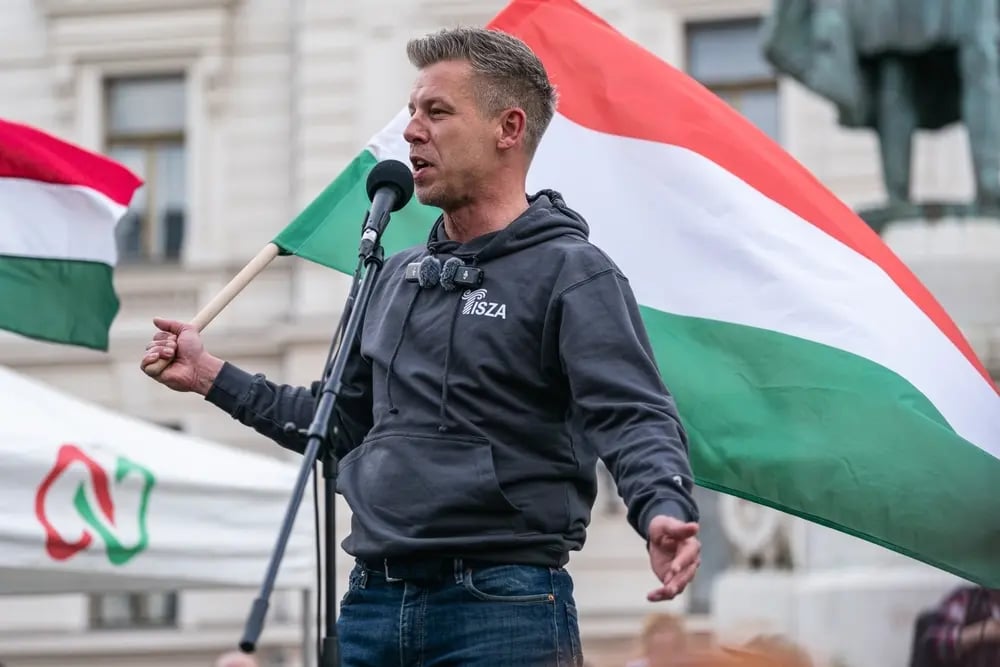
His political movement gained further momentum during national commemorations in March 2024, where he addressed large crowds and announced the formation of a new party. This marked a shift toward movement-based politics (mozgalmi politika) and the construction of a new organisational structure aimed at challenging established parties. His campaign has also included direct accusations of corruption and the release of recorded material, intensifying political confrontation (politikai konfrontáció) in the pre-election environment.
Electoral success followed in the European elections, where his party secured a significant share of the vote and representation in the European Parliament. Although still trailing the ruling party, the result demonstrated emerging political viability (feltörekvő politikai életképesség) and growing public support. Subsequent polling suggested continued momentum, indicating a shift in electoral dynamics (választási dinamika).
Magyar’s rhetoric frequently targets both the current leadership and the traditional opposition. He has criticised previous opposition efforts as ineffective, arguing that meaningful change must come from within the system itself. This approach reflects a strategy of political repositioning (politikai újrapozicionálás) and attempts to consolidate voters dissatisfied with both sides of the existing political spectrum.
Controversies have also accompanied his rise. He has faced accusations and media attacks, including allegations linked to personal conduct. Addressing these claims directly, he stated: “My conscience is clear,” and described the situation as a “honey-trap” operation. These incidents highlight the role of reputational challenges (hírnévvel kapcsolatos kihívások) and media influence (médiahatás) in shaping public perception during election campaigns.
Despite these pressures, Magyar has maintained confidence in his position, emphasising his familiarity with political strategies used by his opponents. “I know them, I know their tricks. I know they're very much frightened,” he said. His campaign ultimately frames the election as a decisive moment, concluding: “This is a once-in-a-lifetime opportunity, not for Péter Magyar but for the country.”
For requests or suggestions: pr@hungarianinstitute.com
Learn the official language of Hungary in 30 days thanks to the most complete Grammar, Vocabulary and Culture course available.
Start speaking Hungarian today!
© Copyright 2026 Hungarian Institute
Come visit Hungary!